
Looking for a Lund Alternative? Why Bushwacker Max Coverage Delivers
If you're shopping for fender flares, you've probably seen Lund's lineup alongside Bushwacker in every search result. Both brands offer extended coverage and OEM-style aesthetics, but the details under the surface tell a different story.
We built Bushwacker Max Coverage to solve the gaps we kept hearing about from truck owners who'd tried other brands first—flares that crack after one winter, paint that fades by spring, or hardware that loosens on the highway. This guide walks through what actually separates our approach from Lund's, so you can decide which platform fits your truck and your timeline.

Material Construction: Where Bushwacker and Lund Diverge
Lund flares ship in two main material families—their Elite series uses a UV-stable Dura-Flex thermoplastic, while their RX-Rivet line relies on ABS plastic with a textured finish. Bushwacker Max Coverage builds every flare from Dura-Flex 2000, a proprietary TPO blend we developed in-house to stay flexible below freezing.
The difference shows up fastest in cold climates. ABS becomes brittle around 20°F, which is why you see so many cracked Lund RX flares in northern states after a single season. Our TPO formulation stays pliable down to -40°F, the same temperature threshold the Society of Automotive Engineers uses for cold-weather component testing. If your truck sees real winter use, that flex matters more than any finish texture.
UV Stability and Long-Term Fade Resistance
Both brands advertise UV protection, but the execution isn’t identical. Lund applies a spray-on UV inhibitor during the molding process, which provides surface-level protection for the first 18-24 months.
Bushwacker Max Coverage integrates UV stabilizers throughout the entire material thickness during compounding, before the flare is ever molded. That means the protection doesn’t wear off—it’s part of the polymer matrix itself. We cover exactly how that process works in our article on how Bushwacker’s sealed UV protection actually prevents fade on modern fender flares, including side-by-side aging test results.
The real test is a flare that’s been mounted for three summers in Arizona or Texas sun. Surface-treated plastics start showing chalky patches and color shift by year two. Through-compounded protection holds its original finish considerably longer.
Hardware Quality and Installation Longevity
Lund packages their kits with zinc-plated steel clips and rivets that meet basic corrosion standards for dry climates. Those fasteners rust through within a year if you drive in salt belt states or near coastlines.
Every Bushwacker Max Coverage kit ships with stainless steel hardware and nylon push clips rated for 10+ year outdoor exposure. The difference costs us about $8 more per kit in component sourcing, but we’ve never had to warranty a Max Coverage flare for rust-through on the mounting points. Lund’s warranty explicitly excludes hardware corrosion after the first 90 days.
If you live anywhere that sees road salt or marine air, that hardware upgrade alone justifies the switch.
Coverage Width and Tire Clearance
Actual Measured Extension
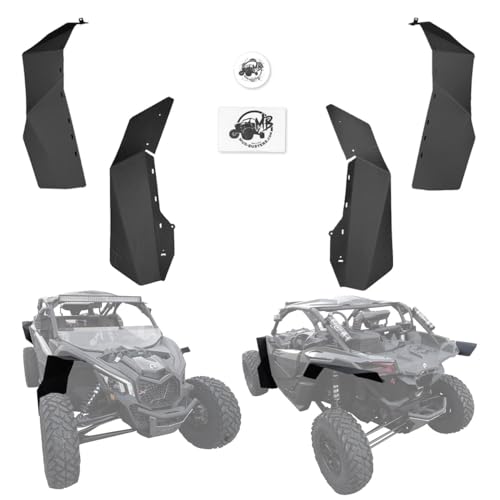
Lund’s Elite and RX-Rivet lines both advertise “extended coverage,” but their widest front flare for a 2019-2024 RAM 1500 measures 2.8 inches from the factory fender edge. Bushwacker Max Coverage for the same truck extends 3.5 inches.
That extra 0.7 inches matters if you’re running 35-inch tires on a leveled truck or 37s on a lifted build. Lund flares leave the top third of the tire exposed once you clear 33-inch rubber. Max Coverage keeps mud and rock spray contained even with aggressive tire setups, which is why you see our flares on serious off-road builds and Lund’s mostly on street trucks.
Wheel Well Protection
Beyond tire coverage, that extra width shields more of your paint from road debris. We’ve seen too many trucks with Lund flares come back with chipped paint along the upper wheel well where the flare stopped short. Our Max Coverage series was specifically designed to overlap that vulnerable zone.

Real-World Durability in Extreme Conditions
The Lund fender flares alternative question usually comes up after someone’s first set cracks, fades, or pulls loose. We designed Max Coverage to handle the conditions that break other flares.
Our testing protocol cycles every new flare design through 500 hours of accelerated UV exposure, 200 freeze-thaw cycles, and simulated highway vibration at 75 mph for 50,000 virtual miles. Lund publishes no equivalent durability data for their RX or Elite series. If your truck lives outside year-round or you put serious highway miles on it, that gap in validation becomes a gap in lifespan.
For cold-weather cracking specifically, we cover diagnosis and permanent fixes in our guide on fender flares cracking in cold weather, but the best fix is a flare that doesn’t crack in the first place.
Making the Right Choice for Your Build
The Lund fender flares alternative search usually means you’ve already identified a gap—coverage width, UV durability, or hardware quality—that matters for your specific truck and how you use it. Bushwacker Max Coverage solves those gaps with measurably wider extensions, through-compounded UV protection, and corrosion-proof stainless hardware.
If you’re building a truck that sees real winter weather, off-road miles, or long-term outdoor storage, those differences add up to years of additional service life. Lund makes a solid street-truck flare for mild climates, but Max Coverage was engineered for the conditions that break other brands.
We stand behind that with a limited lifetime warranty on materials and workmanship, because we built these flares to outlast your truck.
Common Questions When Comparing Fender Flare Brands
Bushwacker Max Coverage typically runs $40-$80 more per four-piece kit than Lund Elite, depending on the vehicle. That difference reflects stainless hardware, through-compounded UV protection, and 0.5-0.7 inches of additional coverage width.
Lund Elite costs less up front but often requires hardware replacement within two years in corrosive environments. If you plan to keep your truck for five-plus years, Max Coverage delivers better total cost of ownership.
Yes, both TPO and ABS plastics accept adhesion promoter and flexible automotive paint. The difference is longevity—Bushwacker's through-compounded UV protection prevents the substrate from degrading under the paint, which keeps your finish from cracking as the plastic ages.
Lund ABS flares often show spiderweb cracking in the paint after 2-3 years because the base plastic becomes brittle first. Max Coverage's TPO stays flexible longer, so painted finishes last considerably more seasons before needing touch-up.
Bushwacker Max Coverage extends 0.5-0.7 inches wider than Lund's widest option for most truck models. If you're running 35-inch tires or larger, that difference determines whether the top of your tire stays protected or throws mud directly onto your paint.
Lund flares work fine for street trucks on 33s or smaller, but serious off-road builds need the extra width Max Coverage provides.
No, Bushwacker and Lund use completely different mounting systems. Switching from Lund to Bushwacker requires removing the old hardware and drilling new holes per our vehicle-specific template.
Installation takes about 90 minutes for a four-piece kit if you follow the included instructions. Both brands mount to the same general fender locations, but the hole patterns don't overlap.
Yes—Lund RX-Rivet uses ABS plastic with surface UV coating and zinc-plated hardware, while Bushwacker Max Coverage uses through-compounded TPO with stainless steel fasteners. RX-Rivet is Lund's budget line and shows it in material thickness and cold-weather performance.
If you're comparing RX-Rivet to Max Coverage, you're looking at two completely different durability tiers. The gap between Lund Elite and Max Coverage is narrower, mostly coming down to UV protection method and hardware quality.
Bushwacker manufactures all Max Coverage flares in the United States at our South Carolina facility. Lund sources most of their RX and Elite production from overseas suppliers, primarily in Taiwan and China.
Domestic manufacturing gives us tighter quality control and faster warranty turnaround, but it also costs more. That's part of the price difference you see between the two brands.